
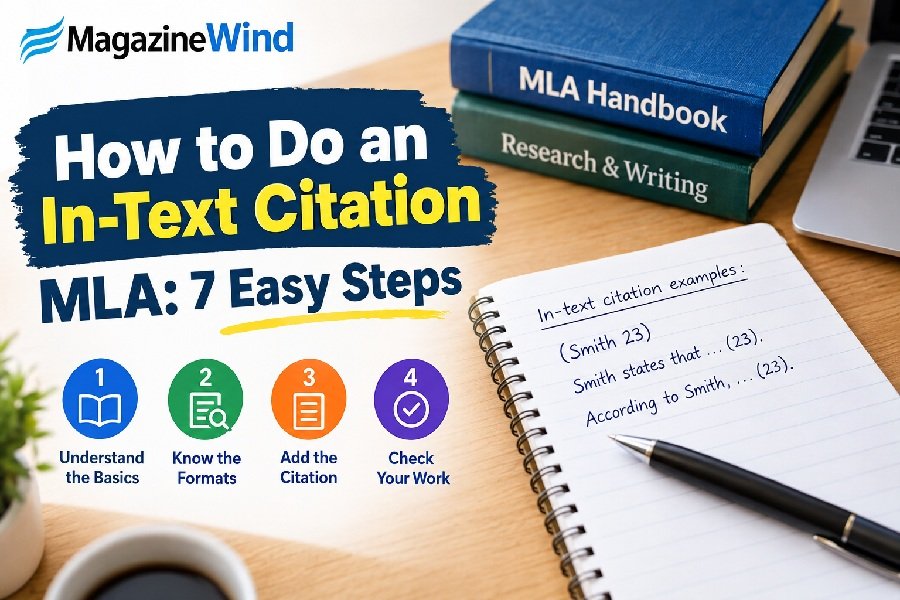
Introduction: How to Do an In-Text Citation MLA
If you are writing a paper in MLA style, you will need to show your reader where your information came from. That is where in-text citations come in. Learning how to do an in text citation mla is not as hard as it sounds. Once you understand the basic pattern, you can cite almost any source with confidence. This guide will walk you through the rules step by step, with clear examples you can follow.
MLA style is used mostly in English, literature, and language courses. It was created by the Modern Language Association, and the latest version is MLA 9, published in April 2021 . The main goal of MLA citations is to help readers find your sources easily. Every in-text citation connects to a full entry on your Works Cited page at the end of your paper.
In this article, you will learn the basic author-page format, how to cite different types of sources, how to handle quotes and paraphrases, and what mistakes to avoid. By the end, you will feel ready to cite sources correctly in any MLA paper.
What Is an In-Text Citation in MLA?
An in-text citation is a short reference inside your paper that tells readers which source you used. It appears right after the information you borrowed, whether you quoted it directly or put it in your own words .
In MLA style, the basic format is the author’s last name and the page number, like this: (Smith 45). This short citation points to the full entry on your Works Cited page. If a reader wants more details about the source, they can flip to the Works Cited page and find it there.
If you mention the author’s name in your sentence, you only need the page number in parentheses. For example: Smith argues that reading habits have changed (45). This is called a narrative citation because the author’s name is part of your sentence.
The in-text citation goes inside the final punctuation of your sentence. For a quote, it goes after the closing quotation mark but before the period . This small detail matters because it shows the citation belongs to that specific sentence.
How to Do an In-Text Citation in MLA
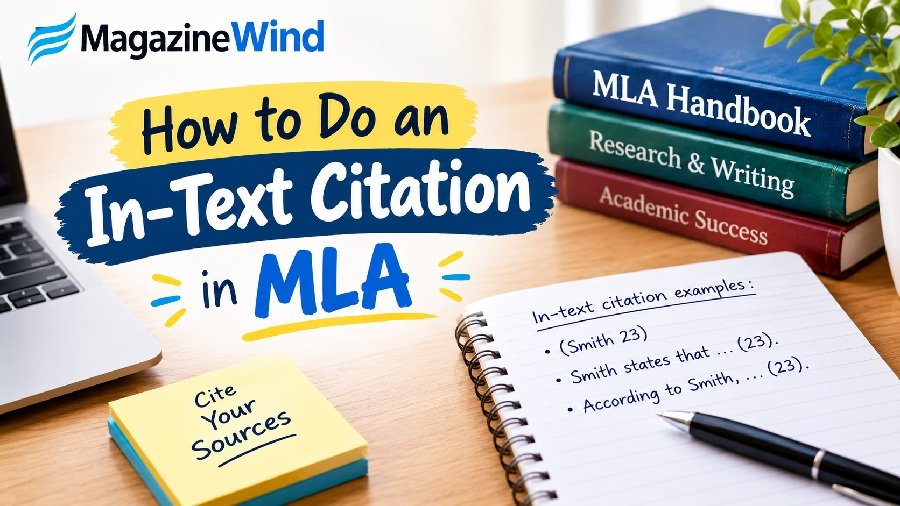
The basic rule is simple: give the shortest piece of information that matches your Works Cited entry. Most of the time, that means the author’s last name and the page number .
Here is the step-by-step process:
Step 1: Identify the author of your source. Use the last name only.
Step 2: Find the page number where the information appears.
Step 3: Put the author’s last name and page number in parentheses at the end of the sentence.
Step 4: Place the citation inside the period.
Example: The novel explores themes of isolation and loss (Hemingway 12).
If there is no author, use a shortened title. If there is no page number, use whatever location marker the source provides, or nothing at all . The key is to match your in-text citation to your Works Cited entry so readers can find the full source.
How to Cite a Source With One Author
For one author, you have two choices: put the name in parentheses or in your sentence .
Parenthetical citation: Romantic poetry is marked by a “spontaneous overflow of powerful feelings” (Wordsworth 263).
Narrative citation: Wordsworth stated that Romantic poetry was marked by a “spontaneous overflow of powerful feelings” (263).
Notice that in the second example, the page number still goes in parentheses even though the author’s name is in the sentence. This is a common mistake beginners make. They forget the page number because the author’s name is already mentioned .
If you cite the same author multiple times in a row, you can sometimes leave out the author’s name after the first citation. But if you switch to a different source and come back, you need to include the author’s name again.
How to Cite a Source With Two Authors
When a source has two authors, include both last names connected by “and” .
Parenthetical citation: Magical realism can be understood as an “ironic narrative strategy” (Takolander and Langdon 42).
Narrative citation: Takolander and Langdon argue that magical realism is an “ironic narrative strategy” (42).
For three or more authors, use the first author’s last name followed by “et al.” The Latin phrase “et al.” means “and others” .
Example: (Baldwin et al. 306).
This rule applies even if the source has ten authors. You only list the first author’s name and add “et al.” in the in-text citation . The full list of authors appears on the Works Cited page.
How to Cite a Source With No Author
When there is no author, use the title instead. If the title is long, shorten it to the first few main words .
For a short work like an article, put the title in quotation marks: (“Impact of Global Warming” 6).
For a longer work like a book or whole website, italicize the title: (Undaunted Courage 45).
The title you use in your in-text citation should match the start of your Works Cited entry. This helps readers find the source quickly . If your Works Cited entry starts with “Impact of Global Warming,” your in-text citation should also start with those words.
Do not use “Anonymous” unless the source itself lists “Anonymous” as the author.
How to Cite a Source Without Page Numbers
Many online sources do not have page numbers. In that case, you simply leave out the page number .
Example: The Lincoln administration was against secession, as it would “create a fatal precedent” (McPherson).
If the source uses paragraph numbers, you can include those: (Chan, par. 2). But do not count paragraphs yourself. Only use numbers the source provides . If the source does not label paragraphs, skip them entirely.
For videos or audio, use a timestamp: (“Moving Day” 00:26:17-52). This helps readers find the exact moment in the video .
For PDFs with page numbers, treat them like print sources. Include the page number in your citation. But if the PDF is just a web page saved as a PDF without real page numbers, treat it like a website.
How to Cite a Direct Quote in MLA
A direct quote uses the exact words from a source. You must put quotation marks around the words and include a citation.
Short quote (four lines or fewer): According to Cuno, “archaeologists have lobbied for national and international laws” (1) .
Block quote (more than four lines): Start the quote on a new line, indent it half an inch, and do not use quotation marks. The citation goes after the final punctuation .
When you quote, make sure the quote fits smoothly into your sentence. Avoid dropping quotes without introducing them. Use phrases like “According to Smith” or “As Jones notes” to lead into the quote .
If you change a word in a quote, use square brackets to show the change. If you leave out words, use an ellipsis (three dots) to show the omission .
MLA In-Text Citation Examples
Here are some quick examples following MLA 9 citation rules:
| Situation | Example |
|---|---|
| One author, parenthetical | (Roy 32) |
| One author, narrative | According to Roy (32)… |
| Two authors | (Talmidge and Lee 67) |
| Three or more authors | (Franck et al. 327) |
| No author | (“Arts funding crisis” 3) |
| No page numbers | (Garcia) |
| Same author, two works | (Elkins, “Visual Studies” 63) |
| Direct quote | “The data shows a clear trend” (Nguyen 88) |
| Paraphrase | The data reveals a clear pattern (Nguyen 88) |
| Block quote | Indented, no quotation marks, citation after final period |
These examples cover most situations you will face in a typical MLA paper.
Common MLA Citation Mistakes to Avoid
Mistake 1: Putting the period before the citation. The citation goes inside the final punctuation: (Smith 45). Not (Smith 45). .
Mistake 2: Using the author’s first name in parentheses. Parenthetical citations use last names only: (Lebo 172). Not (Kate Lebo 172).
Mistake 3: Forgetting the page number for print sources. If your source has page numbers, you must include them for both quotes and paraphrases .
Mistake 4: Using a year like APA style. MLA does not use the publication year in in-text citations. That belongs to APA and Chicago styles.
Mistake 5: Counting paragraphs yourself for web sources. Only use paragraph numbers if the source labels them .
Mistake 6: Not matching the in-text citation to the Works Cited entry. The first word of your citation must match the first word of your Works Cited entry .
Mistake 7: Using “pg.” or “page” before the number. Just write the number: (Smith 45). Not (Smith pg. 45).
Frequently Asked Questions
Do I need a page number if I paraphrase?
Yes, if the source has page numbers. MLA requires page numbers for both direct quotes and paraphrased information .
What if I have two authors with the same last name?
Include the first initial: (R. Miller 12) and (A. Miller 46) .
How do I cite a website with no page numbers?
Use just the author’s name: (Garcia). If there is no author, use a shortened title .
Do I put a comma between the author and page number?
No. The format is (Smith 45) with a space, not a comma.
What does “qtd. in” mean?
It means “quoted in.” Use it when you cite a source that was quoted inside another source: (qtd. in Rogers 333) .
Can I use paragraph numbers for a web article?
Only if the article itself numbers its paragraphs. Do not count them yourself .
How do I cite a YouTube video in MLA?
Use the title or the uploader’s name in your citation. For a timestamp, use (“Video Title” 00:03:15) .
What if my source has no author and no page numbers?
Use a shortened title only: (“Climate Change Effects”). No page number is needed .
Do I cite the Bible or other classic works differently?
Yes. For classic works with multiple editions, include the book, chapter, and verse. For example: (Bible, John 3:16).
Conclusion
Now you know how to do an in text citation mla for almost any situation. The key is remembering the author-page format and using a shortened title when there is no author. Every in-text citation must connect to a matching entry on your Works Cited page . Keep your citations short and clear, and your reader will always be able to find your sources. With practice, MLA citations will become second nature, and you can focus on what really matters: writing a strong paper.