

If you are writing a paper and feel stuck on how to in text cite multiple authors APA, you are not alone. The APA 7th edition rules changed a few years ago, and many students still mix up the old rules with the new ones. The good news is that APA 7 simplified the process: for three or more authors, you now use “et al.” from the very first citation . This guide breaks down the exact formats for two authors, three or more authors, multiple sources in one parenthesis, and direct quotes so you can cite with confidence.
Understanding the Two Main Types of APA In-Text Citations
Before looking at author counts, you need to know where the citation goes. APA uses an author-date system, and you have two options for placing that information in your sentence.
Parenthetical Citations
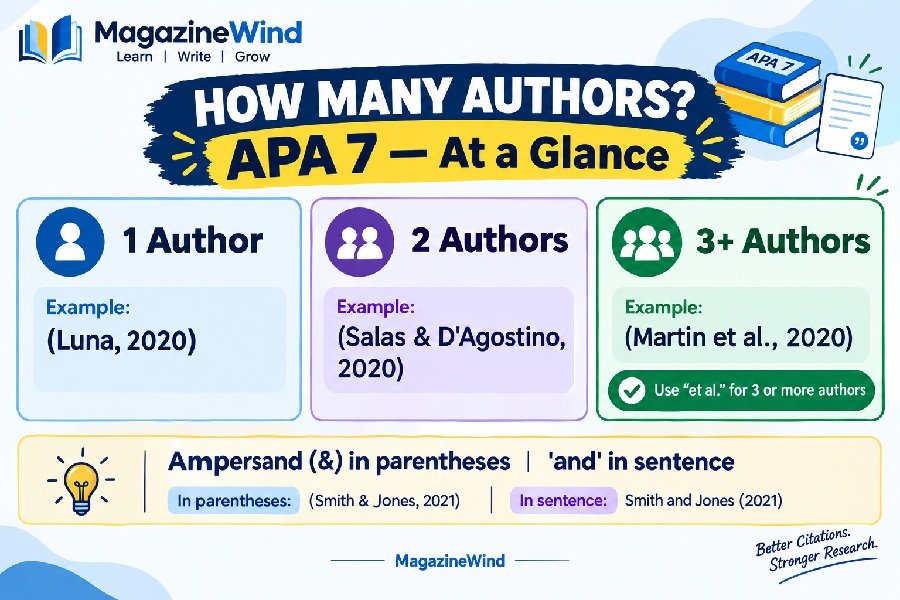
In a parenthetical citation, the author and date appear inside parentheses at the end of the sentence. Use an ampersand (&) between two authors’ names .
- Example (2 authors): The results were consistent across both trials (Salas & D’Agostino, 2020).
Narrative Citations
In a narrative citation, the author’s name is part of the sentence, and only the year goes in parentheses. In narrative text, always spell out the word “and” instead of using an ampersand .
- Example (2 authors): Salas and D’Agostino (2020) found consistent results across both trials.
How to In Text Cite Multiple Authors APA: The Rules by Author Count
This is the core of how to in text cite multiple authors APA correctly. The format changes based on how many people wrote the source.
Two Authors
For a work with two authors, include both last names in every citation . Do not use “et al.” for two authors.
| Citation Type | Format | Example |
|---|---|---|
| Parenthetical | (Author1 & Author2, Year) | (Johnson & Granger, 2018) |
| Narrative | Author1 and Author2 (Year) | Johnson and Granger (2018) |
Three or More Authors
This is where APA 7 made the biggest change. For a source with three or more authors, you only list the first author’s last name followed by “et al.” in every citation, including the very first one . You do not need to list all authors the first time.
| Citation Type | Format | Example |
|---|---|---|
| Parenthetical | (First Author et al., Year) | (Martin et al., 2020) |
| Narrative | First Author et al. (Year) | Martin et al. (2020) |
Multiple Sources in One Citation
When you want to support a statement with several sources at once, list them alphabetically by the first author’s last name and separate them with semicolons .
- Example: (Brown & Williams, 2015; Jackson et al., 1980; King, 2024).
Handling Special Cases in APA In-Text Citations
Citing Multiple Works by the Same Author
If you cite two or more works by the same author, include the author’s name once and list the years chronologically, separated by commas. Place works with no date (n.d.) first .
- Example: (Department of Veterans Affairs, n.d., 2017, 2019).
If the works were published in the same year, add lowercase letters after the year (2020a, 2020b) and list them alphabetically by title in your reference list .
Sources with No Author
When a work has no identifiable author, use the title in place of the author in your in-text citation. If the title is for a short work (like an article), put it in quotation marks. If it is a longer work (like a book or report), italicize it .
- Example (article): (“Ageing and Life-Course,” 2018).
- Example (report): (Stanford University Report, 2020).
Direct Quotations with Page Numbers
When you quote directly, you must include a page number (or paragraph number for web pages). Use p. for a single page and pp. for a range .
- Parenthetical with quote: “The data was conclusive” (Chen, 2018, p. 45).
- Narrative with quote: Chen (2018) stated that “the data was conclusive” (p. 45).
Quick Comparison Table of APA 7 In-Text Rules
| Situation | Parenthetical Citation | Narrative Citation |
|---|---|---|
| 1 Author | (Luna, 2020) | Luna (2020) |
| 2 Authors | (Salas & D’Agostino, 2020) | Salas and D’Agostino (2020) |
| 3+ Authors | (Martin et al., 2020) | Martin et al. (2020) |
| Direct Quote | (Chen, 2018, p. 45) | Chen (2018) … (p. 45) |
| Multiple Sources | (Brown, 2015; King, 2024) | Brown (2015) and King (2024) |
| Same Author, Same Year | (Winston, 2017a, 2017b) | Winston (2017a, 2017b) |
Common Mistakes to Avoid
Even with simplified rules, a few errors appear frequently in student papers.
- Using “et al.” for two authors. The correct format is (Smith & Jones, 2020), not (Smith et al., 2020).
- Forgetting the ampersand in parentheses. Use & inside parentheses, but write “and” in narrative text.
- Listing all authors for 3+ sources. APA 7 requires “et al.” from the first citation. Listing every name is outdated (APA 6) and marks your work as improperly formatted .
- Putting the citation outside the period. In APA, the period goes after the closing parenthesis: … (Smith, 2020). not … (Smith, 2020).
Frequently Asked Questions (FAQs)
1. Do I use “et al.” for three authors or only four?
Use “et al.” for three or more authors. This applies to three, four, five, or any larger number .
2. How do I cite two different authors with the same last name?
Include their initials in every in-text citation to avoid confusion. For example: (A. Singh, 2020) and (B. Singh, 2021) .
3. What if a source has no page numbers (like a website)?
Use a paragraph number instead. Write “para.” before the number. For example: (Smith, 2020, para. 4) .
4. Can I use “ibid.” in APA 7?
No. APA does not use “ibid.” Repeat the full author-date citation each time you refer to the source .
5. How do I cite a group author like the World Health Organization?
Spell out the full name the first time, add the abbreviation in brackets, and then use the abbreviation for subsequent citations. First: (World Health Organization [WHO], 2020). Later: (WHO, 2020) .
Conclusion
Mastering how to in text cite multiple authors APA comes down to remembering a few key distinctions: use & in parentheses and “and” in sentences; use “et al.” for three or more authors from the very first mention; and always include page numbers for direct quotes. When you cite multiple sources together, alphabetize them and separate with semicolons. Keep this guide nearby while editing your paper, and double-check that every in-text citation matches an entry in your reference list. With a little practice, these rules will become second nature.